Buzzumi + Twitter = World Wide Video Chat Service

In the history of this blog I don’t think I’ve ever published a press release — from anyone. Why make an exception now? Because this isn’t an ordinary press release.

I first met Dan Marovitz when we were speakers together in the Innotribe track at Sibos, the worldwide banking conference, in Toronto in September. Dan gave a talk on the essence of money that was an immediate hit — it instantly became known as the “mackerel talk”.

The next day was the first time he’d seen a demo of Connect.Me, and he could not wait to dive into it with me. The reason was he saw a perfect fit with buzzumi, his new Internet video/audio/text chat service that — get this — requires NO client and NO signup.

That’s right. Free video/audio/text chat from any modern browser – all it requires is a link.

And his business model is equally clean: the host of any buzzumi session can charge, by the session or by the minute, and for paid sessions, buzzumi gets a 10% fee.

It’s knowledge commerce, stripped down to its essence: pure pay-per-thought.

Which is why there’s such an obvious fit with Connect.Me: helping people know the reputation in advance of who they want to buzzumi with, whether free or paid.

What’s really cool is what he’s announcing today: a Twitter bot that lets you start a buzzumi session with as many attendees as you can fit Twitter names in a tweet (right now buzzumi can do video chat for up to 6 people).

Details of the buzzumibot are in the release below, which is why I’m passing it on wholesale rather than retyping it. But the bottom line is: buzzumi rocks — I’ve used it a half dozen times now and it’s as addictive as Skype but less hassle and more flexible.

Go Dan! Let’s make this knowledge commerce thing happen!

FOR IMMEDIATE RELEASE

London, England December 6, 2011

buzzumi announces the ability for Twitter users to launch real-time video, audio, and text chat with their friends and followers, straight from Twitter.

This innovation has been created by buzzumi.com, the recently launched London-based video chat and webinar start-up. Entering a public beta in November this year, buzzumi.com offers users extremely light-weight yet powerful video chat rooms and large-scale webinars. The company was founded by Daniel Marovitz, a former senior executive of Deutsche Bank in London, and previously, iVillage.com in New York.  The company is about to close its first outside round of funding. buzzumi can be used for debates, chats, interviews, or webinars.  Hosts can start a chat for free or decide to charge for a session or a webinar using the integrated payments capability. If users decide to charge for a webinar or online consultation, buzzumi takes a 10% commission on the ticket price.

How it works: Twitter users simply send a public tweet to @buzzumibot, and include the Twitter handles of the individuals with whom they would like to chat in the tweet. @buzzumibot will immediately respond with a link to an instantly created video chat room. No additional log-ins or sign-ups are required. The users can get chatting with audio, video, and lightning-fast text in seconds, all in a platform and browser-agnostic chat room.

“The functionality to launch a video chat directly from Twitter is significant, as buzzumi allows users to extend Twitter discussions and debates into a more interactive environment, while staying in the “Twitterverse,” says CEO, Marovitz. buzzumi brings a whole new world to Twitter, allowing a range of highly interactive discussions that were never possible in the text-only service.

The buzzumi chat technology is 100% browser-based and requires no additional software downloads or installations.  The Twitter video chat platform is a direct result of buzzumi’s commitment to making online video chat easier, hassle-free and quicker to set-up than ever before. Frictionless communication.

To find out more about buzzumi, please visit buzzumi.com. For press enquiries please send an email to info@buzzumi.com.

Posted in Connect.Me, Knowledge Commerce | Leave a comment

Connect.Me: One Month In

Trust is a very delicate matter — especially online, where most if not all of the cues (location, appearance, diction, body language) we use to make trust decisions in the physical world are absent. To make matters worse, the rampant growth of the Internet has caused countless spammers and scammers to take advantage of this, making us even more wary about anything new that purports to build trust.

Which is what makes the Connect.Me private beta so interesting and exciting.

When we opened it up the first small group of users on our beta signup list a month ago today, we could hardly wait to see how they would proceed with real social vouching across their real social networks. At first it started slowly, with lots of hand-holding, but then after about 10 days something kicked in, and last weekend we passed 100,000 vouches. Some users (particularly those active on social media) have made hundreds of vouches. As just one example, UC Davis microbiology professor Jonathan Eisen has vouched for 172 people and received 42 vouches.

As you might expect, some people receiving notifications of those vouches on LinkedIn or Facebook assumed it was a new type of social spam. After all, who on the social web has not experienced a site or app trying to trick you into automatically inviting all your friends?

It’s like every user has to be constantly asking every site: “Are you a good witch? Or a bad witch?”

To make matters worse, the first week we had a few bugs in the notification system, and the UI controls over notification were not clear enough. To users who tripped on those bugs, we must certainly have looked like a bad witch.

But as we fixed those issues, we started seeing the magic that happens when those same users begin looking under the hood to find out what’s really going on with this new network. They visit our trust page, take a glance at the Respect Trust Framework, and start understanding how the game dynamic of the network builds escalating levels of trust. Suddenly a lightbulb goes on. “Hey, this is different. Nobody’s trying to steal my data here. In fact they are actually trying to help me protect it.”

Bingo. We’re not in Kansas anymore. We’re on the other side of the rainbow of user-generated trust. And while no one’s promising a yellow brick road to the land of Oz, this is going to be one helluva journey.

If you’re intrigued and can’t wait for your beta invite, see this article on the Connect.Me blog. You can also watch this video interview Buzzumi CEO Dan Marovitz did with me yesterday. To learn more about the next features coming in the Connect.Me private beta, see this new blog post by CEO Joe Johnston.

And if you’re really passionate about user-generated trust, we invite you to contact us about becoming a Founding Trust Anchor. Instructions are in this short paper on the Connect.Me blog.

Posted in Connect.Me, General, Respect Trust Framework, Social Web | 1 Comment

Support for this Hypothes.is

I’m an advisor to the Hypothes.is project led by Dan Whaley. If you care about the subjects on this blog, I implore you to do two things:

  1. Watch Dan’s 5 minute video introducing Hypothes.is (at the top of the Kickstarter project page).
  2. Give whatever you can – even $5 – to the project.

It’s this simple: Hypothes.is stands to do for annotations across the Web what Wikipedia did for a global community-managed encyclopedia.

It won’t be easy, but with the team Dan’s assembled, it can be done, and the results can be as transformative as Wikipedia.

Please help get it started by making a contribution to meet the Kickstarter goal. Don’t delay – there are only 6 days left.

Posted in Genius, Reputation | Leave a comment

Love, Crazy, Stupid, Love.

I hate it when life gets so busy there’s not time for blog posts. They start to stack up mentally in a queue like unread books. Since the holidays are still too far away to look to them for spare time, I’m just going to pop out several mini-posts this weekend.

The first is a passionate rave for Crazy, Stupid, Love. I saw it with my wife in August but still laugh just thinking about it. And cry. In a word, it’s the best romantic comedy in at least a decade. It’s as funny, if not funnier, than Little Miss Sunshine. But it’s also heartwarming in a way that does that overused term proud. Most of all, it is so brilliantly written, directed, and acted by every single cast member that you leave the theatre just tingling with joy.

I saw one review in the New York Times that said Crazy, Stupid, Love proves they still know how to make romantic comedies. Wrong. This one proves they know how to make them even better.

P.S. Don’t waste the chance — see it with your sweetie.

Posted in Movies | 2 Comments

Update on Personal Event Networks: The Evented API Spec

As a follow-on to my post about Personal Event Networks last week, Phil Windley and Sam Curren have published the Evented API Specification. Phil’s blog post about it gives a good summary, but if you’re a developer just go straight to the spec — it’s short and very easy to read.

I expect this will be a major topic at Internet Identity Workshop next week – I plan to be all over it.

Posted in Events, General, XDI | Leave a comment

He Was Da Man

From the Apple website, 2011-10-05

Posted in Genius | Leave a comment

Phil Windley on Personal Event Networks

Phil Windley has a new post called Personal Event Networks: Building the Internet of Things. The idea is simple but highly compelling: what if the range of products and services you used could actually talk to each other, over the net, on your behalf? Technically this talking is known as “raising events”, i.e., being able to notify each other that something important has happened.

A simple example is your car telling your calendar that you are due for an oil change. Or your calendar being able to tell your home thermostat that you are going to be away for the weekend — thus saving you from having to manually tell it to save the heat (when was the last time you remembered to do that?)

Many things become possible if your personal network of devices, products, and services can safely talk to each other in ways they can all understand. That’s what Phil is promoting through a simple event interface. It dovetails wonderfully with the two main thrusts of my work over the past several years:

  1. Connect.Me and the Respect Trust Framework is about building a strong, socially-verified web of trust so the different devices, products, and services in your personal event network can trust each other — and even more importantly trust the personal event networks of your family, friends, and co-workers. (The total value of a personal event network goes up exponentially with the number of other personal event networks it can be safely connected to.)
  2. XDI is developing the semantic data sharing protocol that will give all the devices, products, and services on your personal event network a common language in which to speak to each other. XDI is perfect for eventing because, although it works fine for request-response interactions, it does not require them. Instead, XDI messages can also use the publish/subscribe model needed by an event network– and in fact XDI link contracts are ideal for dynamically defining subscriptions and sharing rights.

Phil is writing a book called The Live Web, and I’m hoping that personal event networks will play a key role in explaining the power the Live Web will bring.

Posted in Connect.Me, General, Respect Trust Framework, XDI | Tagged , , | 2 Comments

The Height of Insidiousness

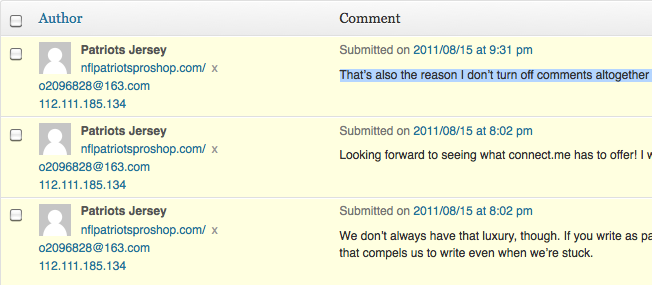
On January 19 I did a short post titled I am so ready to get rid of these. It was about blog spammers winning the war against WordPress’s Akismet spam filter. What enraged me most is that if a comment gets pass Akismet, it is clever enough that it requires scrutiny by a real human (me) to determine if it is genuine or not. And even if 9 times out of 10 it’s spam, that 10th time it might be from someone whose comment I really value. I summed up the dilemma this way, “That’s the reason I don’t turn off comments altogether — the value of the real comments outweighs the hassle of the spam.”

Now the spammers have a new tactic that makes me completely blow a gasket. Yesterday I received a comment to the very same I am so ready to get rid of these post that consisted of one line:

That’s also the reason I don’t turn off comments altogether — the value of the real comments outweighs the hassle of the spam.

I literally had my mouse cursor poised over the “Approve” button because my first reaction was, “Right on — I agree with that comment completely!”

And then I had a tiny flicker of deja-vu…

…where had I seen that phrase before…?

DAMN!

I looked closer and saw that in fact I had 3 comments in a row on 3 different posts, all from “Patriots Jersey” and all using this “quote from the post” technique.

It’s so simple and clever I’m surprised I haven’t seen it before (for all I know it’s been around for ages and I’m just seeing it for the first time). But it completely fried my gourd, because thousands of real bloggers might be fooled into approving these comments the same way their blog spam filter was fooled into accepting them.

For me it was even more validation why we need move to higher level reputation systems  based on real people and real trust relationships, not machine algorithms. That, in a nutshell, is why I’ve been working on Connect.Me and the Respect Trust Framework for the past year.

More on how this can help fight blog spam coming soon.

Posted in Blogging, Connect.Me, Spam | 1 Comment

Steve Jobs & The Courage of Great Design

There have been many tributes to Steve Jobs over the past few days but I found this short one by Bob Blakley to be particularly eloquent.

All I know is that the company headed by this man has created the breathtakingly elegant digital environment I spend the majority of my waking hours in, and the amount of beauty and joy that has brought to my life — and that of my wife and two sons — is impossible to put into words.

Thank you Steve. I wish you and your family happiness for every moment you have left on this earth.

(The photo is from Bob’s post, where he credits: http://www.flickr.com/photos/home_of_chaos/4645091860 – Creative Commons BY License.)

Posted in General | Tagged , , | Leave a comment

A Love Letter to J.K. Rowling

For me, it all ended — magnificently — in the cozy confines of the Empire Theatre on Block Island, RI. Having raised our two boys reading Harry Potter books out loud, and seeing several of the movies on various July vacations over the past decade, it was fitting to see the last installment of the last movie on our last day of summer vacation in this historic setting. The theatre was originally a roller skating rink; it is so quaint you can hear the rain on the roof. Vents need to be manually opened around the sides of the atrium if it gets too hot.

After the movie my sons (now 19 and 16) were incredulous that I didn’t even hear the vents being opened half way though. That’s how was engrossed in the story I was. What does it say about the power of a film that, even when you have read and re-read the book, you are still completely entranced by its telling on the big screen?

A Sorting Hats-off to David Yates for his direction; to Steve Kloves for his taut, elegant screenplay; to the entire cast for inhabiting their characters with depth and charm, above all Alan Rickman, who — in conjunction with Steve Klove’s deft screenplay — helped me understand more about Severus Snape that I ever got from the book itself. For me, it is a first that a movie could exceed a book in this respect.

When it was all over, and we were eating waffle cones under the stars in a park next to the outrageously good ice cream parlor behind the theatre, I found myself treasuring most the gift J.K. Rowling has given all of us. When I stopped to think of how many hours of pleasure, wonder, and awe traveled from the tip of her pen to the imaginations of my sons; how deeply her stories had become intertwined with their childhood and our parenthood; and how the fantasy magic of Harry Potter had become almost synonymous with the real magic of our summer vacations to a family reunion in Maine; I wanted to cry right there in my hot fudge-covered Deer Tracks ice cream.

Thank you, J.K. Rowling, for a gift more precious than all the gold in Gringott’s. Harry Potter may be fantasy, but the magic you made was real.

Posted in General, Movies | Tagged , , | Leave a comment

Fire in the Firehose

When I see a tweet with a title like 21 Ways to Create Compelling Content When You Don’t Have a Clue I want to run screaming. As if we need any more clueless content clogging the Internet firehose. There’s a reason “curation” appears to be the fastest-growing meme on the net right now.

But since it came from a reasonably credible source, I was curious why anyone would promote such a concept. The article starts off with this:

Sometimes you’re just flat out of ideas.

It’s not a matter of talent — you’ve written great stuff in the past. But lately, when you go back to the well for a fresh idea, it’s coming up dry.

This happens to the best of us — even veterans who consistently produce quality content have their off days.

Yet they continue to write.

They may grumble about how hard it is to get going and create something solid, but they still do. Again, and again, and again.

They aren’t super-human, and they don’t have magical content-producing powers. So what is the secret?

They do it by pulling out the well-worn toolbox of strategies for creating awesome content.

And then it goes on to list 21 (actually 22 with the bonus) strategies for overcoming the creative dry heaves by following tried-and-true formulas for creating new content.

I wanted to cry.

Not because it isn’t a real problem. Or because some writers wouldn’t sell their soul for a solution.

But because reaching for some tried-and-true formula is akin to inviting a fleet of Dementors to suck out your creative soul (if you’re not a Harry Potter fan, you should be — it’s hard to imagine J.K. Rowling having writers block).

One of my other all-time favorite authors, Robert Pirsig, had some very choice words about this creative dilemma in Zen and the Art of Motorcycle Maintenance. From Chapter 16:

As a result of [Pirsig’s] experiments he concluded that imitation was a real evil that had to be broken before real rhetoric teaching could begin. This imitation seemed to be an external compulsion. Little children didn’t have it. It seemed to come later on, possibly as a result of school itself.

In sum: if you can’t think of something original and valuable to say, put down the pen. Take a nap. Take a hike. Take a different job. But for God’s sake don’t try to manufacture “content” that isn’t burning a hole inside of you to get out.

Insist on fire in the firehose. The world will be a brighter place.

Posted in Blogging, Creativity | 2 Comments

Super Super 8

J.J. Abrams brings the same Red Bull energy and Maserati plot to Super 8 as he did to 2009’s Star Trek (the movie that compelled me to start adding film notes to my blog). But it feels much more intense and personal because this is his own childhood story he’s telling here.

It helps that Steven Spielberg, co-producer, shared those same Super 8 childhood adventures and dreams. By the end of the film you can’t help but see how the two are linked.

In my humble opinion that’s the path to the deepest truth in film. A projection of the director’s own experience. The mind’s eye becomes the camera’s eye. J.J. Abrams frames it beautifully.

Posted in Movies | Leave a comment

The Keys to the Keys

Craig Burton has penned another crystalline piece called How to Spot an Unnecessary Identity Fail (after his previous piece, How to Divine the Bovine, this is starting to sound like a field guide to identisaurus). His key point: we’ve had asymmetric key cryptography for 30+ years and we are still storing usernames and passwords on servers where they can be ripped off.

What’s wrong with this picture?

In an IM session with him I pointed out that while moving entirely to asymmetric keys is a giant security win (because your private key is never stored on a server, at least not unencrypted), the problem has always been the usability of foisting private key management on the user (which is the only place it can truly be and still retain the full security advantages). Even Microsoft with their design for Information Cards (which are the closest we’ve ever come to full asymmetric key-based security infrastructure) never fully solved that problem.

Craig’s point is: that’s where the innovation needs to happen. Focus on that one fracture point and you can split the entire Internet security boulder.

And if you use password digests, or fancy split-key recovery protocols such as those Ben Laurie has been working on at Google, you end out not storing a secret anywhere except in a user’s head.

Keep that in mind as you start to watch personal clouds unfurling in the personal data ecosystem. They just might have enough rain (and thunder) to crack that boulder.

Posted in Blogging, I-Cards, Information cards, Personal Cloud, Personal Data Ecosystem | 3 Comments

Craig Burton Divines the Bovine

There are few people I have met in my career who can distill complex topics down to their very essence. Craig Burton is one of them. His Burton Ubiquity Matrix, about which he gave a great session at the last Internet Identity Workshop, is IMHO one of the paragons of insight about the requirements for Internet infrastructure. (I follow its lessons religiously.)

His most recent essay, How to Divine the Bovine, combines his wry sense of humor with his spot-on-test for when a data sharing relationship leads to a MOO moment.

What’s a MOO moment? Let Craig explain…

Posted in Blogging, Data Portability, Personal Data Ecosystem | Leave a comment

Shift Giving to Nature

I have been super heads-down in the last month with the pre-beta launch of Connect.Me (yes, I know it sounds funny, there’s not even into the real beta yet and there was still a great deal to announce at IIW, EIC, and PII – see the Connect.Me blog for details). But now that I’m back in Seattle, I finally had the time to visit the new site created by my good friend Andrew Currie called Shift Giving to Nature.

I simply cannot recommend it highly enough. I’ve know Andrew since we worked together on The Internet Adapter back in 1993, and I can’t recommend him highly enough either (just tagging him on tag.connect.me doesn’t do him enough justice). Anything Andrew tackles he does superbly or not at all, so when he told Joe Johnston and I at SXSW that he wanted to create a site that would shift more charitable giving to the environment and wildlife, I knew it was going to be powerful.

Please visit called Shift Giving to Nature, watch the video, and tell me if you don’t agree.

Posted in Blogging, Environment | Tagged , | Leave a comment

Privacy is nuanced

I saw Joe Andrieu at the Personal Data 2.0 Workshop this past week and he just did a post about privacy that makes a very important point: “public” and “private” are not black and white. They are highly nuanced and dependent on context and choices that every individual makes.

So the only way we’ll get to online systems that respect privacy the same way people are able to in the offline world will be to make it extremely easy for people to make the same contextual choices about what is shared with whom and why — and to have the same degree of confidence that those wishes will be respected.

For more about this point, see the series of Connect.Me blog posts about the Principles of Personal and the Respect Trust Framework.

Posted in Connect.Me, Personal Data Ecosystem, Privacy | Leave a comment

When Josh Spector posted a link to this commercial…

…it was before the triple disaster hit Japan.

Now visit his blog and watch this commercial and see how powerful it is now.

Thanks Josh.

And thanks to Ernesto Diaz for tweeting about it.

Posted in Blogging, Movies | Leave a comment

The Connect.Me Blog

With Connect.Me finally having a public-facing beta signup process, even though we’re otherwise still in stealth, we’ve started a Connect.Me blog to start explaining what Connect.Me the company is about. The first post explains our overall focus on personal data and trust frameworks, an issue highlighted by this week’s TIME Magazine cover article.

Today’s post is a set of Connect.Me stories from SXSW, the Disneyland of social media, which had a strong set of sessions around the personal data issue.

So if you want to follow the progress of Connect.Me , that’s where I’ll be covering it. Equals Drummond will remain focused on my standards work; broader topics in Internet identity, data sharing, and trust; and those personal topics I cover from time to time (like the films I’m crazy about).

Posted in Blogging, Connect.Me, Personal Data Ecosystem, Privacy | Leave a comment

Connect.Me

The Incredible Internet Irony Machine strikes again. The stealth startup that’s been my singular focus since stepping down as Executive Director of Open Identity Exchange and the Information Card Foundation last fall, called Respect Network, took one tiny peek above the covers last night — quietly opening the beta invitation signup page for our Connect.Me service before SXSW starts in a couple days.

After internal testing of the signup process we just wanted to do a little bit of live external user testing of the signup before SXSW. So my co-founder Joe Johnston took off the password protection on the page and before going to bed last night we asked a few family and friends to test it.

We woke up this morning to over 10,000 users. And that grew to 20K in a few hours.

But that’s not the ironic part.

While Joe and I were in a meeting with one of our key partners in building this new network, we were barraged with links to a post by Graham Cluley on Naked Security entitled Connect.me rush exposes risky behaviour of social networkers. In it, Graham points out:

Every day we seem to warn the readers of the Naked Security site about the danger of rogue applications and unknown parties gaining access to your social networking accounts.

And so you would think people would be wary of allowing a third-party app, which doesn’t explain its intentions and doesn’t explain who’s behind it, from gaining access to their Facebook or Twitter account.

But that’s exactly what tens of thousands of people are doing right now with Connect.me.

Now we get to the height of irony: the reason this new network is called Connect.Me is to address the privacy and control issues around social login and social data sharing. After spending the last decade building user-centric identity and data sharing infrastructure (just peruse this blog for acres of details), Joe and I and the Connect.Me team, which includes Marc Coluccio and Dean Landsman, were acutely aware that the game had already been won…by the social login services. As of last December, Facebook Connect was being installed on over 10,000 sites per day.

And we are even more acutely aware of how little people understand about the privacy implications, i.e., that Facebook (or Twitter or LinkedIn or whomever you use for social login) has a complete list of all your site relationship information. Not to mention all the data you share via this login.

That’s not a knock on Facebook, Twitter, LinkedIn, or any other social network. They are incredible services that have literally changed the world — far beyond just the social web landscape. But their spectacular success does not mean that the entire future of the social web must be sharing all our data and relationships through centralized social hubs.

Shouldn’t there be an option for you to better control your data, identity, and relationships?

That’s the core premise of a groundbreaking idea called VRM (Vendor Relationship Management). VRM isn’t new — it’s been a project at the Harvard Berkman Institute led by Doc Searls since 2005. Read all about it on the ProjectVRM site. Or look for the Twitter hashtag #vrm.

It’s also the core premise of the Personal Data Ecosystem Consortium and the unflagging leadership of Kaliya Hamlin and Mary Hodder, who have been at this just as long as we have. See especially their responses to the U.S. FTC Do Not Track proposal and the Dept. of Commerce Privacy green paper.

So Joe and I and the rest of the Respect Network team said: let’s build a service that operates by the principles of VRM.

We’ll share more about what we’re building over the next few weeks. It’s a big vision that will take time to fully realize, but we’ve started the ball rolling with Connect.Me. And we’re thrilled that our seemingly quiet launch stirred up controversy about a critical topic: privacy on the social web.

So, thank you, Graham. It’s not what we intended but then the Internet is not what anyone intended either — it’s become the beautiful electronic organism that we are all building together, and with Respect Network and Connect.Me we’re trying to make it better.

If you agree, here’s what you can do to get involved:

  • Sign up for the beta at Connect.Me. Use my personal invite code: http://cxt.me/n62QnQ. Tell ’em I sent you 😉
  • Follow @respectconnect on Twitter.
  • If you’re a developer and want to be deeply connected to this effort, drop us a line at jobs@connect.me.
  • If you’re a user who cares deeply about having a personal data trust framework for the Internet, drop us a line at anchors@connect.me. We have a very special role for you.
Posted in Connect.Me, Data Portability, Dataweb, Identity Rights Agreements, Open Identity Exchange, Personal Cloud, Personal Data Ecosystem, Personal Data Server, Personal Data Service, Personal Data Store, Privacy, Reputation, Social CRM, Social Web, VRM | 16 Comments

Doc Tallies the State of VRM

I recently posted on how VRM is moving from theory to practice, but if you want a sense of just how many signs there are, check out Doc Searl’s post on The State of the VRooM.

(And that’s not even quite everything — stay tuned. 🙂 )

Posted in Personal Cloud, VRM | Leave a comment